Walk 1: Cheapside
Ambulanti mihi dudum in foro …
As I was recently walking in Cheapside, the market place, …
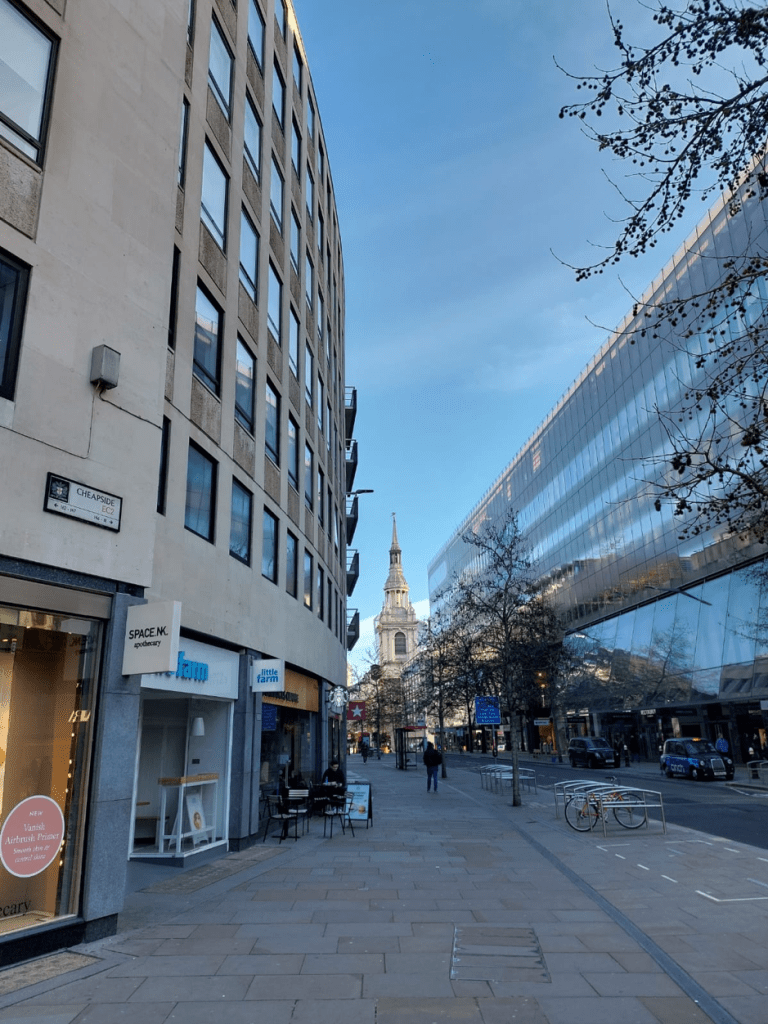
We start our walk at one end of Cheapside, along the busy market place. Behind we have St Paul’s cathedral. We step forward towards the east, the lanes right and left are named by the trades that supply the market: Friday Street, the fishmongers, Bread Street, Wood Street, …
2nd Stop: Milk Street
From Cheapside we turn north onto Milk Street.


Here Thomas More was born on 7 February 1478, as recorded by his father on the memorandum now kept in Trinity College, Cambridge.
3rd Stop: St Lawrence Jewry
From Milk Street we turn right towards the Church of St Lawrence Jewry.
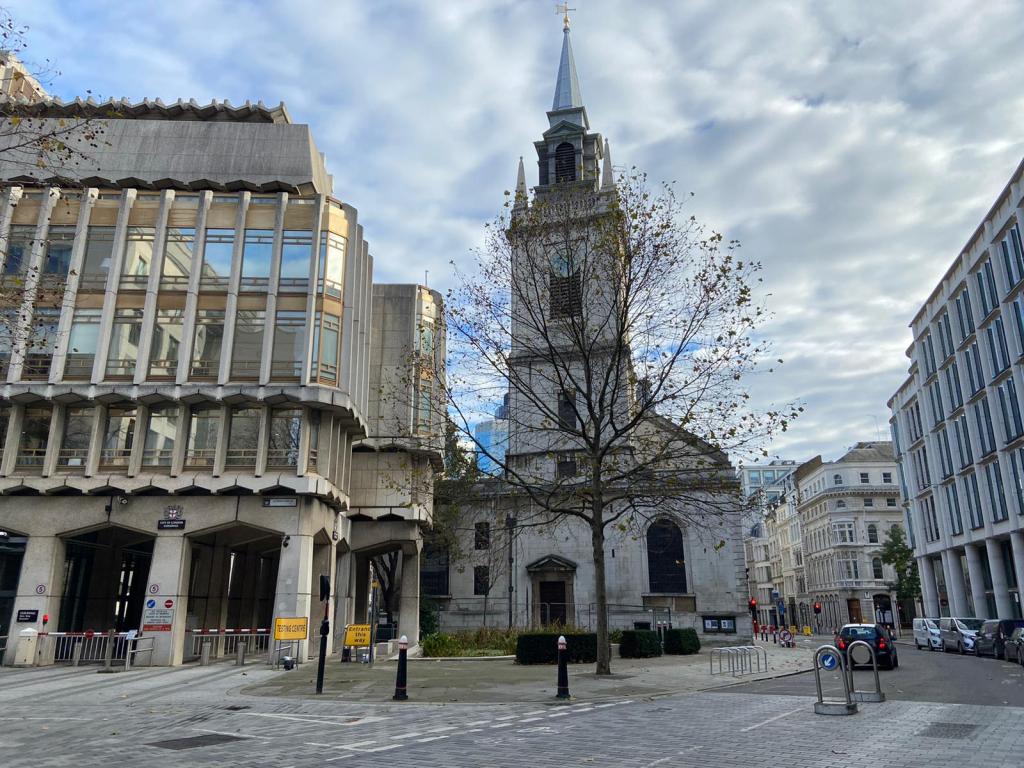
The church is a typical neoclassical building as most of the London “City Churches”. It was designed by Christopher Wren. It is oriented to the orient! And it has nice stained-glass east windows, but the most striking stained-glass windows are the five in the south façade.


1. In entering the church, the most prominent of these is the stained-glass window of Thomas More next to the sanctuary.
NOTE FOR THE GUIDE: The church of St Lawrence Jewry is probably the best place to introduce the visitors to the life of St Thomas More. The church is open Monday to Friday, it provides a free-entry to a sheltered space, whatever the weather, and often there are not many other visitors. While inside the Tower of London the pilgrims are obviously restricted by the entry cost and the required permission, and are meant to focus on the last days of More, in St Lawrence the speaker can cover any aspect related to More at leisure, such as
- His early life
- His encounter with Erasmus in 1499
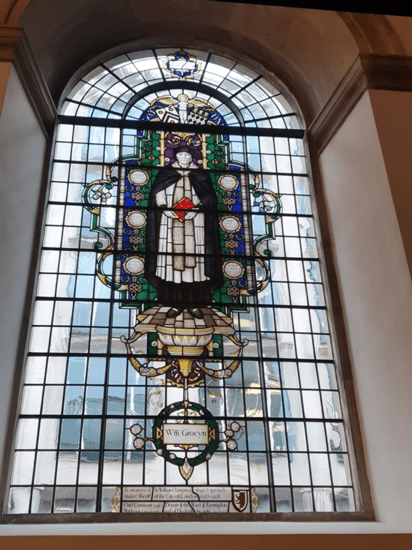
- His study of Greek under William Grocyn who is portraited in one of the present stained-glass windows
- His lecturing on the City of God of St Augustine in 1501
- And his reputation in the late 19th century and in the 20th century.

2. The other stained-glass windows are also related to Thomas More.
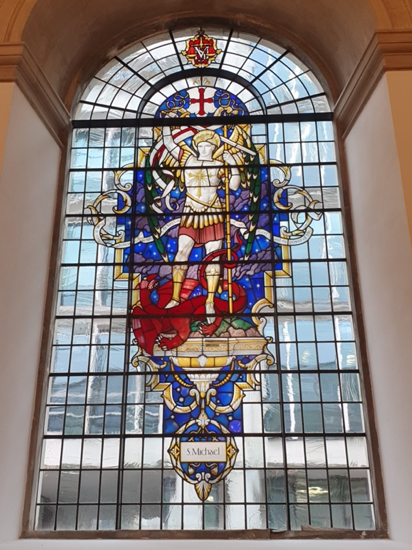
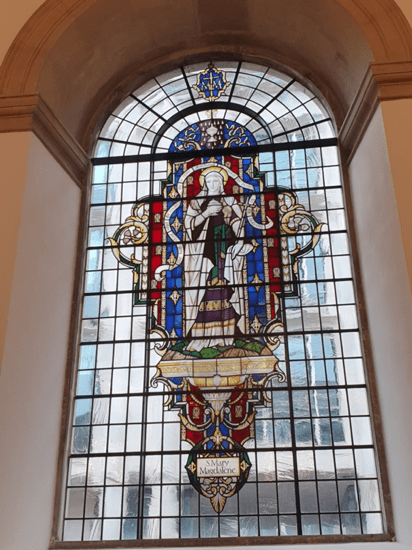
The central windows are dedicated to St Michael, St Mary Magdalene, and St Lawrence. This building is at present a Church of England guild church. A guild church is one that has no parish responsibilities in order to minister full time to non-resident city workers during their hours in the city.
The church was originally built in the twelfth century. In 1618 the church was refurbished and windows were filled with stained-glass. The gothic church was destroyed in the Fire of London in 1666 and rebuilt by the architect Christopher Wren soon after. The parish of St Lawrence was then amalgamated with that of St Mary Magdalen, Milk Street, whose church was not rebuilt. In 1892 the parish of St Michael Bassishaw was also joined with that of St Lawrence after the church of St Michael fell into disrepair and collapsed. This explains having here these three stained-glass windows. St Michael, as patron of the universal Church, is placed in the centre.
The three original parishes had close connections to Thomas More. The church of St Mary Magdalen’s parish was in Milk Street and therefore it is probable that More was baptised there. Thomas More lectured on the City of God at St Lawrence, and his father was buried at St Lawrence. Thomas More’s mother was buried at St Michael’s, and her epitaph written by her son was placed at her grave.
The texts on the stained-glass windows of St Mary Magdalene and of St Lawrence are also inspiring.
For St Mary Magdalene it reads:
“She hath done what she could. She is come aforehand to anoint my body to the burying.”
Thomas More had a great devotion of the Magdalene for her generosity towards Christ. More mentions her in several of his writings, pointed out that Jesus said that she shall be praised wherever the Gospel is preached. In the opinion of this author, More commissioned Holbein a painting of the Risen Christ appearing to her.
The text in the stained-glass window of St Lawrence reads:
“Be thou faithful unto death and I will give thee a crown of life”
which we can very well apply to the martyrdom of Thomas More.
3. William Grocyn
The western window of the south façade is that of William Grocyn, rector of St Lawrence from 1496, the year that Thomas More started his studies of Law at New Inn, a preparatory school near and depending on Lincoln’s Inn. On the upper part of the window there is a quotation from Erasmus:

The quotation reads: “The patron and preceptor of us all”. Erasmus is referring to the group of humanists he met during his stay in England in 1499: John Collect, Thomas Linacre, and Thomas More… For the relevance of William Grocyn, see Thomas More’s Vocation.
4. Reputation in the 19th and 20th centuries
As said, St Lawrence is at present a guild church of the Church of England and the official church of the Lord Mayor of London and the City of London Corporation. How is it that Thomas More is praised here?
In 1899 Henry Charles Richards (1851-1905), QC and MP for Finsbury East (1895-1905), commissioned a stained-glass window to be dedicated to Sir Thomas More, to mark the 400th anniversary of More lecturing on the City of God of St Augustine in this church in 1501.
Richards was educated at the City of London School. The school was founded in the 15th century by John Carpenter. In 1837 the school opened its doors in Milk Street on the site that have been occupied by the church of St Mary Magdalene. If it is assumed that he was there aged 11 to 16, that would mean that he was there until 1867. In 1882 the school moved to Victoria Embankment, in a building, corner with John Carpenter Street, overlooking the River Thames. High on the west and south façades of the new building there are statues of prominent Londoners; Thomas More, on the west façade is one of them. Richards was the City’s representative on the school board from 1882 to 1885; therefore, he could have been involved – prior to his appointment to the board – in the decision to place the statue there or – if not instrumental in that decision – he could have been influenced by it.
Richards was also a very active “high church” member of the Church of England. He was appointed chairman of the City Branch of the Church Defence Institution in 1877 and three years later formed the City Church and Churchyard Preservation Society.
All this gives some explanation about a link between Richards and Thomas More, though further research is required.
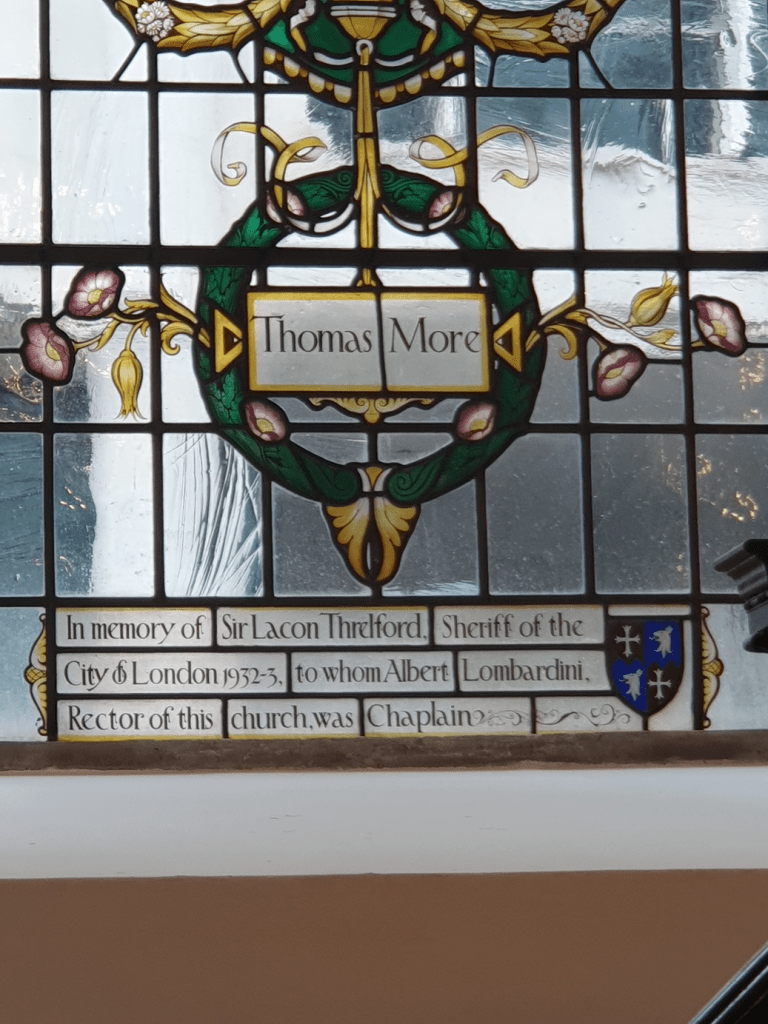
What is not yet explained is why the Corporation in 1957 decided to install a new stained-glass window of Thomas More in Memory of Sir Lacon Thelford, who had been Sheriff of the City before the war, and why mention a previous rector, Albert Lombardini.
Mitjans, 30 April 2023
 Thomas More Research