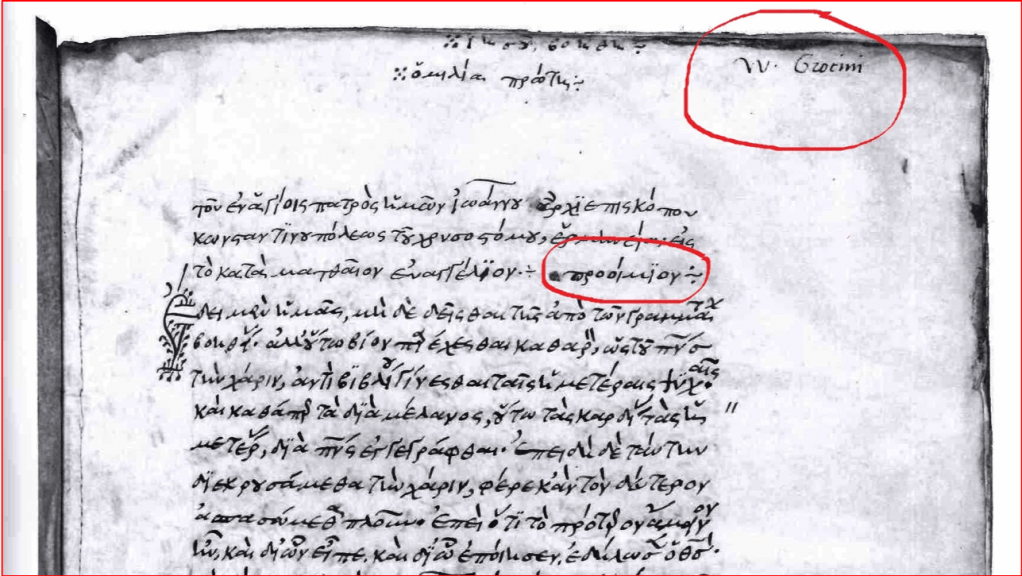
Homilies on the Gospel of St Matthew, St John Chrysostom, new manuscript copied for William Grocyn, September 1499, Corpus Christi College, Oxford, MS 23
St Thomas More and St John Chrysostom, December 2016
Moreana, Volume 53 (Number 205-206) Issue 3-4, Page 128-142, ISSN 0047-8105, December 2016
To download the full text, click here: https://www.euppublishing.com/doi/abs/10.3366/more.2016.53.3-4.9?journalCode=more
Abstract
In the introduction to Translations of Lucian, More wrote that “of all learned men” Chrysostom was “the most Christian and – at least in [his] opinion – of all Christians the most learned.” It is worth considering how much they were in tune. In 1499 More had access to a new manuscript of Chrysostom’s Commentary on the Gospel of St. Matthew, now in Corpus Christi College. In the first homily Chrysostom gives an overall view of his work and of the teaching of Christ and writes that the apostles brought us a “new principle of life, another manner of living: both in wealth and in poverty, in freedom and in slavery, in life and in death, changing all, our world and our polity. Not like Plato who composed that ridiculous Polis.” That reference to the Republic of Plato is echoed in the Hexastichon of Utopia, Nunc ciuitatis aemula Platonicae / Fortasse uictrix. More deliberately used the word civitas rather than respublica; for in this way he came closer to the word used by Plato and Chrysostom, πολιτεαν. The key theme of that first homily of Chrysostom, addressed to the citizens of Antioch, is that the teaching of Christ is to be practised in the “polis” and in the “agora.” Reference to both the city and market place is to be found also in the letter More addressed to Colet in October 1504. This essay will consider the influence of Chrysostom on More at the time of his writing Utopia.
 Thomas More Research
Leave a comment