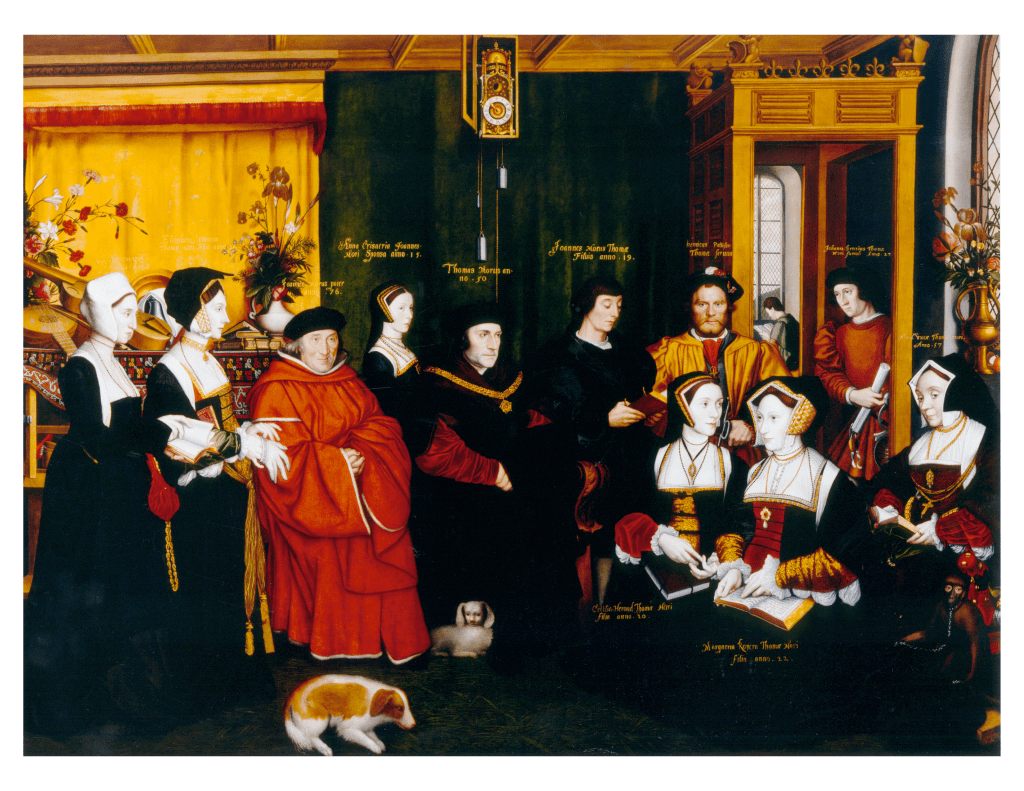
The Family of Sir Thomas More, Rowland Lockey, 1592, oil on canvas, 250.2 × 301.1 cm, Nostell Priory, Yorkshire ©National Trust Images/ John Hammond.
Oedipus’s Riddle: Elizabethan transformation of the family portrait of Thomas More, an Appendix to “Non sum Oedipus sed Morus”, December 2019
Moreana, Volume 56 (Number 212), No. 2: pp. 133-159.
To download the full text, click here: https://www.euppublishing.com/doi/abs/10.3366/more.2019.0058
Abstract
Holbein produced a drawing of Sir Thomas More and his Family which was a preparatory sketch for a larger painting. The painting was acquired by Karl von Liechtenstein-Kastelkron (1623–95), Archbishop of Olomouc, Moravia, and was last recorded in 1691 as being kept in the episcopal residence in Olomouc; it is generally assumed that the painting was lost in the 1752 fire at the Archbishop’s château in Kroměřiž. There are, however, five extant versions of the Family Group. The three main versions are the full-sized oil on canvas, The Family of Sir Thomas More (1592), now at Nostell Priory, and two paintings of Sir Thomas More, his Household, and Descendants: one kept at the National Portrait Gallery, the other at the Victoria and Albert Museum, London. There has been much discussion about the transformation from a family at prayer—as portrayed in the original drawing—to a conversation on Seneca. Based on editions of Oedipus prior to the Nostell painting, the history of More’s descendants, and a cameo that belonged to More’s family, this paper argues that the Elizabethan transformation is a story of conformity and non-conformity.
Holbein fit un dessin intitulé Sir Thomas et sa famille pour servir de croquis préparatoire en vue d’un grand tableau. Le tableau fut acquis par Charles von Liechtenstein-Kastelkorn (1623–1695), alors prince-évêque d’Olomouc en Moravie, et conservé, selon une dernière référence en 1691, dans la résidence épiscopale en Olomouc ; il est généralement admis que le tableau périt lors d’une incendie au palais épiscopal de Kroměřiž en 1752. Pourtant, cinq versions du groupe familial existent encore. Les trois principaux, grandeur nature, sont peints à l’huile sur toile: La famille de Sir Thomas More (1592), désormais conservé au Nostell Priory, et deux autres tableaux de Sir Thomas More, son ménage, et sa descendance conservés à Londres, l’un à la National Portrait Gallery et l’autre au Musée Victoria and Albert. La métamorphose thématique du tableau d’une famille en prière—thème du dessin original—à une conversation sur Sénèque a donné lieu à beaucoup de discussions. L’argument de notre article, basé sur une considération des éditions de l’Œdipe antérieures au tableau de Nostell, de l’histoire des descendants de More et d’un camée appartenant à sa famille, présente cette métamorphose comme un récit de conformité et de non-conformité.
 Thomas More Research
Leave a comment